
Skip to content

The measurement system

VaultLab reads the attempt in five phases. The numbers stay connected to the frame, the phase and the coaching question they answer.

Follow Dallin’s best attempt
Dallin Thornton in the approach phase01
IMG_1326

01 · Approach

Build the energy budget.

27.4FT/S

Speed matters only when the rest of the jump converts it.
Approach speedft/s
How fast you are actually moving over the last few strides before the plant — the energy budget for the whole jump.
Dallin Thornton in the plant phase02
IMG_1326

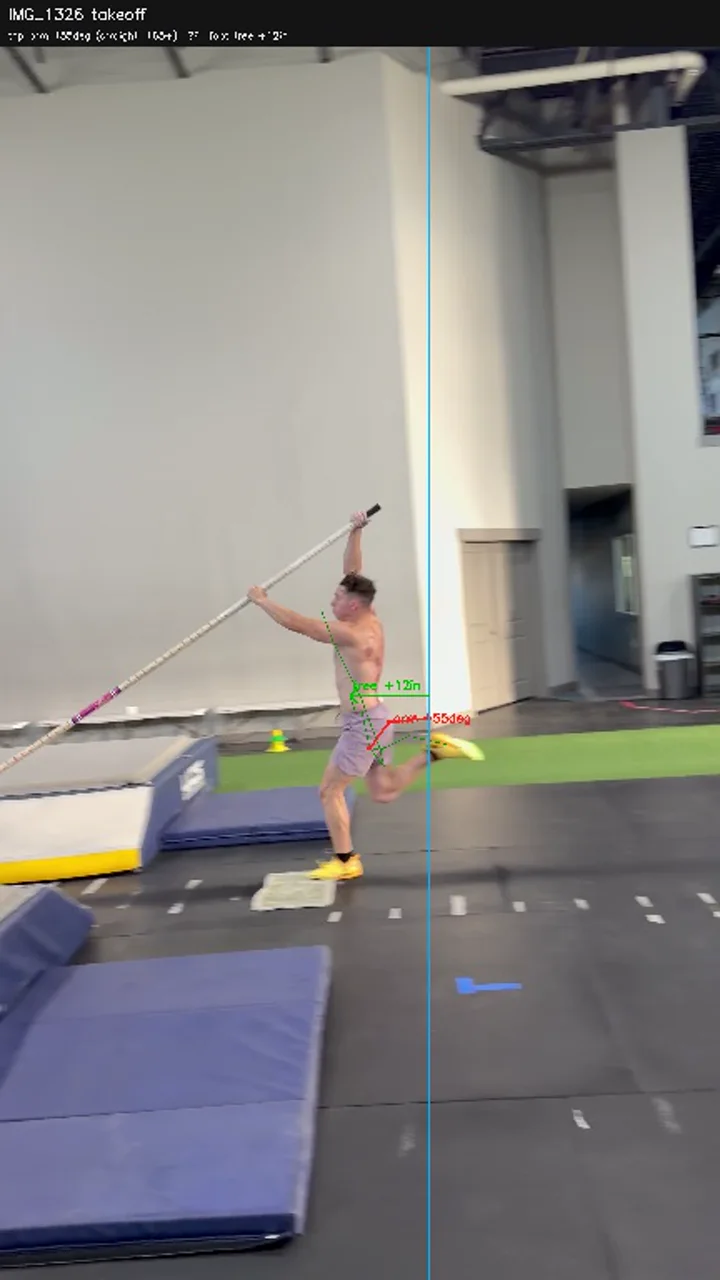
02 · Plant

Give the run to the pole.

155°TOP ARM

Grip, extension and foot position show whether the pole receives the run cleanly.

Takeoff distanceft
How far your takeoff foot is from the back of the box. Too close and the pole eats your speed; too far and you never load it.
Takeoff foot vs. top handin (under / free)
Whether your foot is behind your top hand at plant (under) or out in front of it (free). Under is the single most common leak in the sport.
Top-arm extensiondeg
How straight your top arm is at the plant. A bent top arm collapses the pole in on you and kills the swing before it starts.
Grip heightft
Where your top hand is on the pole, measured from the ground. Every other number gets read against this one.
Dallin Thornton in the takeoff phase03
IMG_1326

03 · Takeoff

Choose the direction.

20°TAKEOFF

The takeoff angle shows whether the athlete travels through the pole or climbs into it.

Takeoff angledeg
The angle your body leaves the ground at. Too steep and you jump up into the pole instead of through it.
Dallin Thornton in the swing phase04
IMG_1326

04 · Swing

Put the body on the return line.

169°INVERSION

The finished rock-back lets pole recoil become height instead of sideways motion.

Pole angle and benddeg / % chord
How far the pole has rotated and how deep it is bending. Tells you whether you loaded it or just leaned on it.
Max trunk inversiondeg
How far past vertical your torso gets — the rock-back. 170 deg is fully upside down. Stall at 60 and the pole gives the energy back to the ground instead of to you.
Dallin Thornton in the finish phase05
IMG_1326

05 · Finish

Convert the jump into height.

+8′3″ABOVE GRIP

Push and apex height reveal how much of the jump reached the bar.

Push above gripft
How far above your top hand you get at the finish. This is the number that turns a good swing into a bar height.
Apex hip heightft
The highest point your hips reach. The honest ceiling of the jump, independent of what bar you had on.

Jump 1326 · measured scorecard

The numbers belong
to the same attempt.

Five headline signals from Dallin’s real best jump, kept in phase order.

01Approach speed27.4 FT/S

The energy brought into the plant

02Top-arm extension155°

How completely the plant posted

03Takeoff angle20°

The direction leaving the ground

04Max trunk inversion169°

How fully the rock-back finished

05Push above grip+8′3″

The height created after inversion

Measurement is not the prescription

Ten signals become useful
when one is ranked first.

#1 RANKED FINDINGFinish the rock-back.

11 of 19 attempts stalled near 57° instead of reaching roughly 170°.

Open the 19-jump evidence

Get started

Measure the whole jump. Act on the one signal that matters next.

One complete measured jump is free. No card required.