Skip to content

VaultLab field notes

Technique, measurement and coaching ideas that begin with a real frame, a real distribution or a number worth changing.

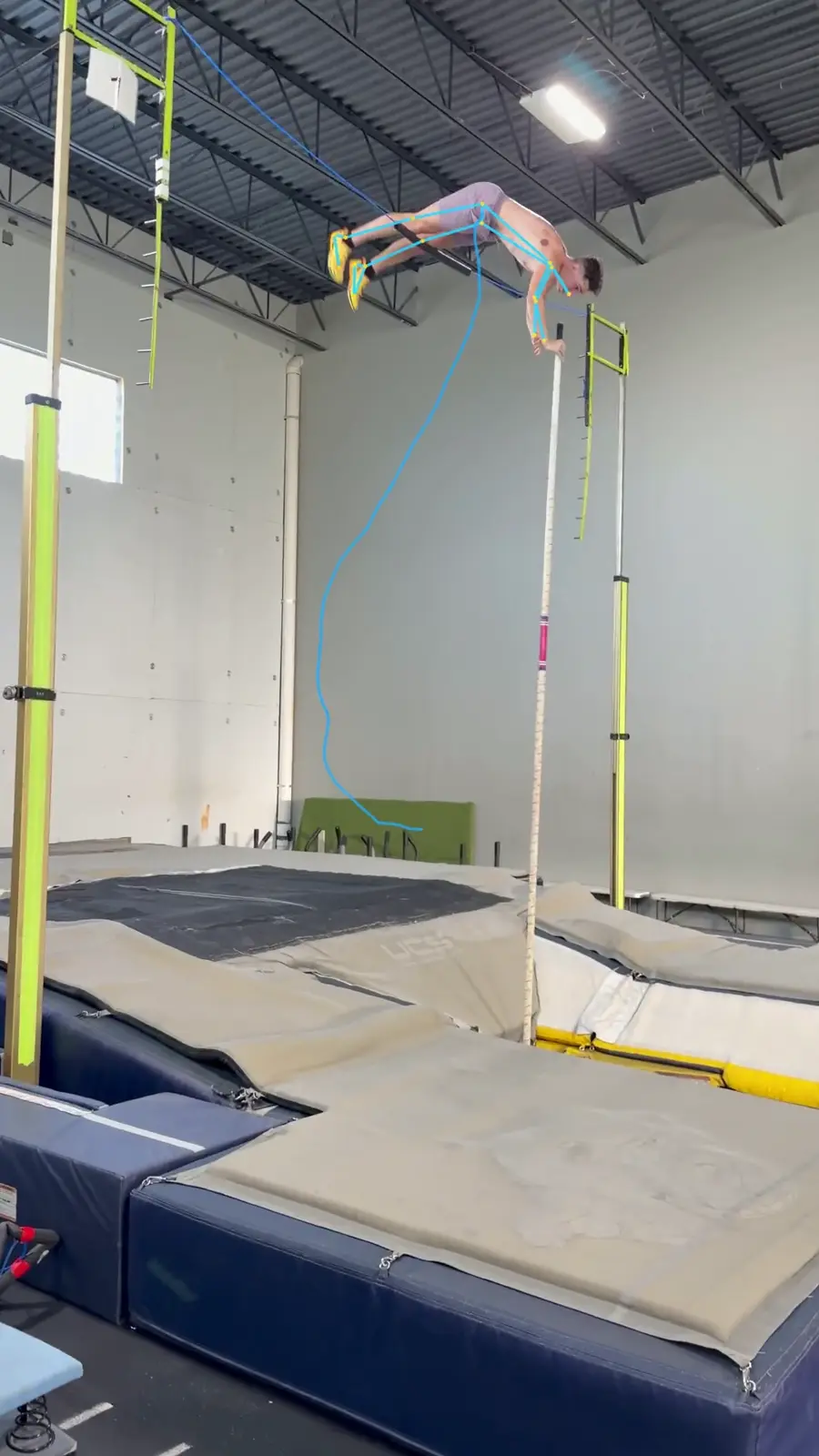
Dallin Thornton finishing the inversion phase
FIELD NOTE 01169°The position that changed the session
01 · TechniqueWhy finishing the rock-back matters more than raw speed4 min read ↓02 · DiagnosisHow to tell if you are taking off under5 min read ↓03 · TrainingWhat a private lesson cannot give you: reps3 min read ↓
Dallin Thornton frame illustrating why finishing the rock-back matters more than raw speed
169°FINISHED ROCK-BACK
IMG_1326 · DALLIN SESSION

01 · Technique · 4 min

Why finishing the rock-back matters more than raw speed

Every vaulter has been told to run faster. Almost none of them have been told the number that actually predicts their next PR: how far past vertical their torso gets before the pole recoils. Speed sets the ceiling of a jump. Inversion decides how much of that ceiling you collect.

Here is the mechanical reason. When you plant, the pole stores the energy you brought down the runway. It gives that energy back on recoil — but only along the line your body is on at the moment it straightens. If your torso is at 60 degrees when the pole starts to return, most of that stored energy pushes you sideways and out, not up. Finish to 170 degrees and the same pole, the same speed, the same grip sends you straight up the line of the pole. Same input, dramatically different output.

This is why an athlete can add a full foot per second on the runway and see nothing on the bar. In one session we measured, three separate jumps shared the fastest approach of the day, 27.7 ft/s — the exact same speed, the exact same runway. One stalled at 52 degrees of inversion. One reached 140. One finished the rock-back at 170. Same fitness, same speed, three different outcomes. The best jump of that session was not even the fastest one — it was 27.4 ft/s, a hair off the top, but it finished to 169 degrees and pushed 8 feet 3 inches above the grip. The variable that separated those jumps was never speed. It was timing.

The practical takeaway: before you spend an off-season adding speed, find out what percentage of your jumps actually finish. If it is under half, you are leaving height on the runway that no amount of extra speed will collect.
See the source session
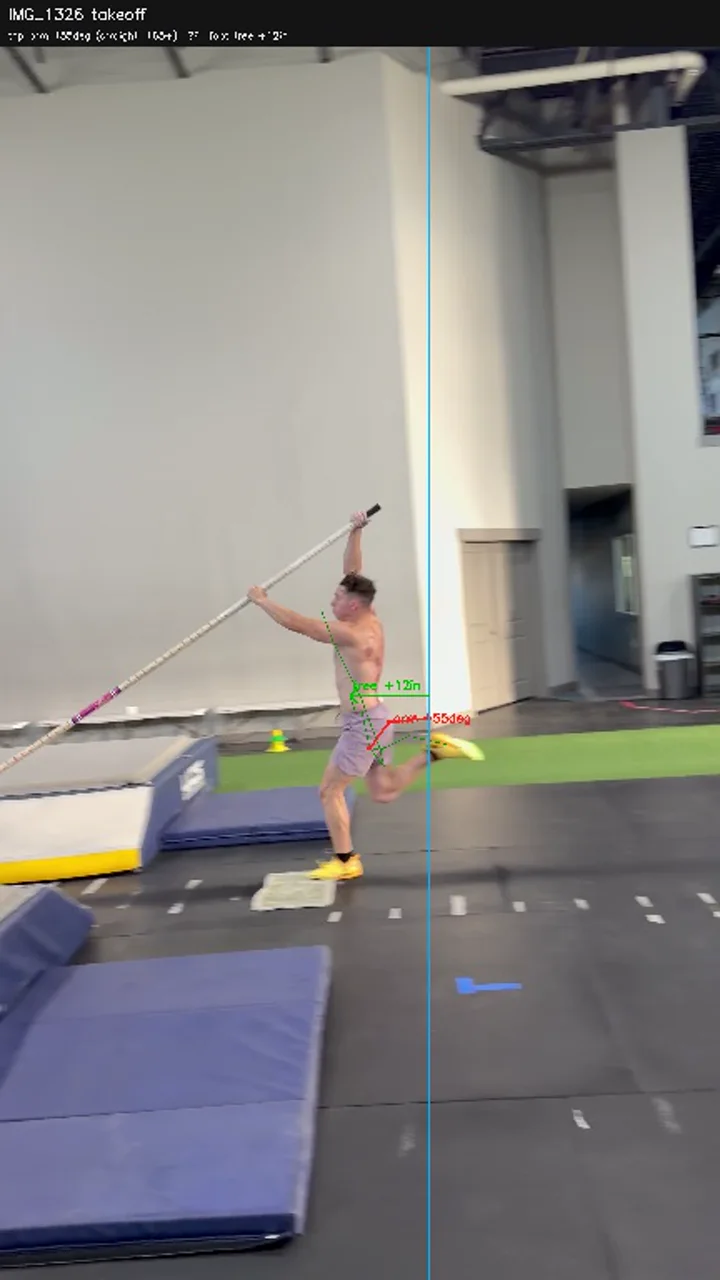
Dallin Thornton frame illustrating how to tell if you are taking off under
5 INUNDER TAKEOFF
IMG_1326 · DALLIN SESSION

02 · Diagnosis · 5 min

How to tell if you are taking off under

Taking off under means your takeoff foot lands behind a vertical line dropped from your top hand. Being free means it lands in front of that line. The difference between the two is usually four to six inches, it lasts about a fortieth of a second, and it is nearly impossible to see in real time — which is why so many vaulters spend seasons fighting a problem they have never actually confirmed they have.

The symptoms are recognizable even without measurement. You feel the pole stop you rather than carry you. Your top arm collapses because the pole is loading before your body has left the ground. The swing feels late and heavy. You blame the pole and go stiffer, which makes it worse. Coaches call this jumping into the pole, and the standard cue — move your step back — is correct but useless without knowing how far back.

The fix is a number, not a feeling. If you know you are five inches under, you move the standard back five inches and re-measure. If you are two inches free and losing pole bend, you know to leave the step alone and look at grip instead. Guessing costs you a season; measuring costs you one jump.

The one thing worth internalizing: under is not a strength problem or a courage problem. It is a step-mark arithmetic problem, and arithmetic problems have exact answers.

See the source session
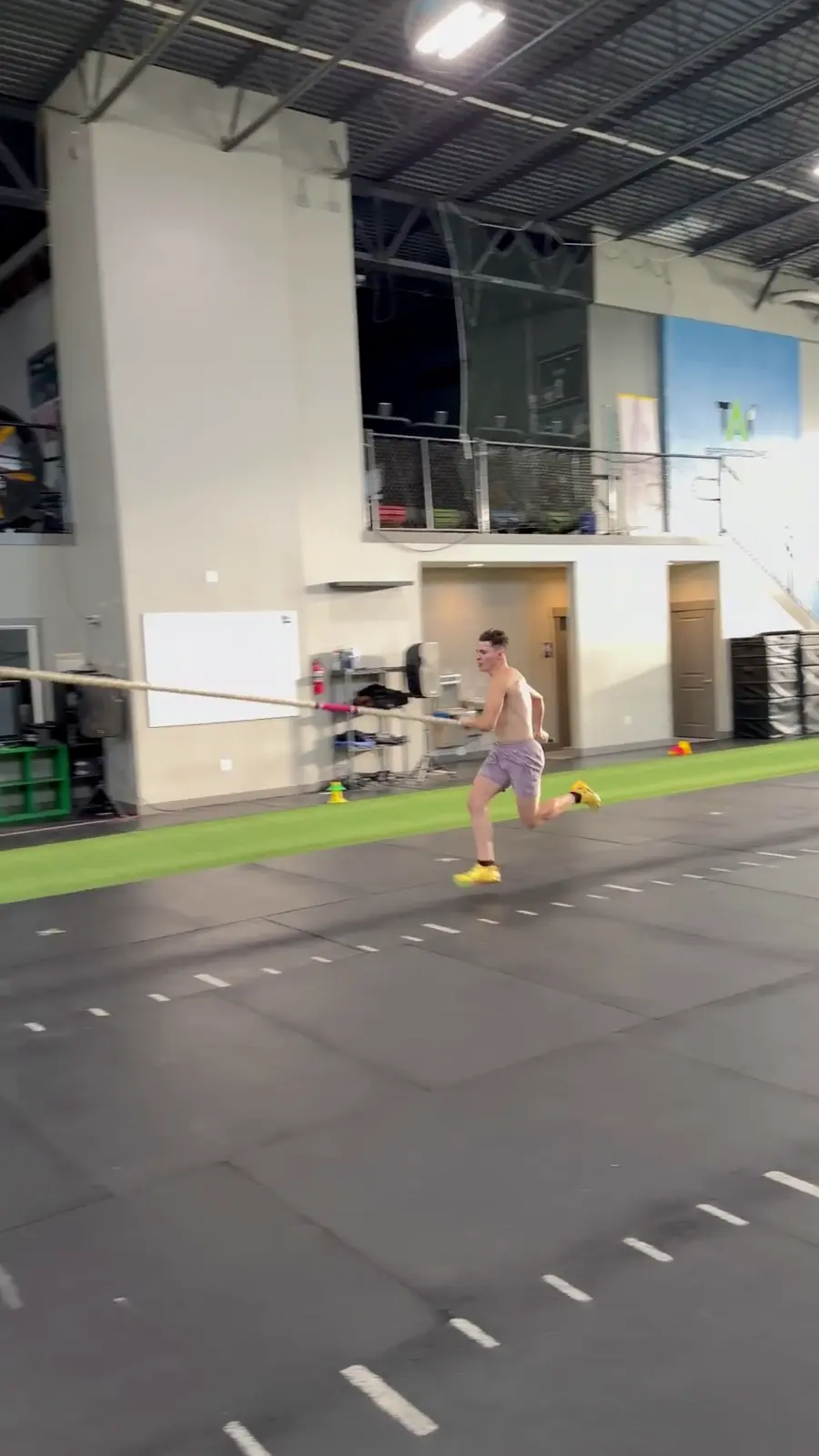
Dallin Thornton frame illustrating what a private lesson cannot give you: reps
19MEASURED REPS
IMG_1309 · DALLIN SESSION

03 · Training · 3 min

What a private lesson cannot give you: reps

A good private vault coach costs between forty and eighty dollars an hour, and is worth it. In one session a coach can spot things no software can: your mindset on the runway, how you carry the pole under fatigue, whether you are scared of the standard. That is real, and this is not an argument against it.

But a lesson is a snapshot. You get an hour every week or two, and every jump you take in between is unobserved. That is where technique quietly drifts. You feel good about a session, you go home, and three weeks later your step is six inches off and nobody caught it because nobody was watching those particular fifty jumps.

The gap is not coaching quality. It is coverage. A vaulter who takes 400 jumps a season and gets 20 of them looked at closely is running on 5 percent feedback. The other 95 percent is memory and vibes. Measurement fills the gap between lessons — not by replacing the coach, but by handing them a season of data instead of a season of anecdotes when you do sit down together.

See the source session

Editorial standard

If it does not change practice,
it does not get published.

Every field note links the idea back to footage, measurement and the limits of what the evidence can support.

Get started

Turn your own jumps into evidence.

One complete measured jump is free. No card required.